
Showing posts with label judo. Show all posts
Showing posts with label judo. Show all posts
Friday, February 27, 2015

Friday, February 13, 2015
Tai Sabaki
The biggest current master of Judo, Kyuzo Mifune has repeatedly stated: « Tai sabakl is the first and last step of judo. » This extraordinary expert who extended the same concept of Tai Sabaki, considers this art as gasoline. even judo and all human action. Tai Sabaki literally
means «dodge the body, turning movement body, defending the body by turning »,
1. Theory, to easily understand the basics of Tai Sabaki, consider the plan as a body axis (shoulder line) pivotable about its center of gravity (fig.1). If an opponent

1. Theory, to easily understand the basics of Tai Sabaki, consider the plan as a body axis (shoulder line) pivotable about its center of gravity (fig.1). If an opponent
pushes on one end of the shoulders, the body will pivot on its center. It will respond in the same manner when pulled to the one end. To be able to disrupt the balance of the body and disturbing the position, It would apply the push or pull the center of the body. This is why the
old masters teach: « Always face your opponent, but never to his face attack.»
The center, the hub of rotation, therefore becomes the vulnerable point.
But it is perfectly possible to move this and wear it for example at the ends (Fig.2). In this case, the body rotates around the axis passing through the shoulder and the left hip, for example, and ending on the left foot. This is what happens in judo during a projection. Under the principle of greatest lever arm, These techniques use the end of the body as the axis. Thus in a projection as ippon-seoi-nage, Tori pivots on his right foot around the axis of the shoulder and right hip, by launching the other end to his back left, the body, that is to say, shoulder, hip and left leg. This powerful rotary motion transmits its energy to the left arm that pulls Uke around the pivot axis. As soon as the left foot is placed on the ground, the kinetic energy is transmitted to the right shoulder and in part to the right hip will move to the new axis of the shoulder and left hip.
But it is perfectly possible to move this and wear it for example at the ends (Fig.2). In this case, the body rotates around the axis passing through the shoulder and the left hip, for example, and ending on the left foot. This is what happens in judo during a projection. Under the principle of greatest lever arm, These techniques use the end of the body as the axis. Thus in a projection as ippon-seoi-nage, Tori pivots on his right foot around the axis of the shoulder and right hip, by launching the other end to his back left, the body, that is to say, shoulder, hip and left leg. This powerful rotary motion transmits its energy to the left arm that pulls Uke around the pivot axis. As soon as the left foot is placed on the ground, the kinetic energy is transmitted to the right shoulder and in part to the right hip will move to the new axis of the shoulder and left hip.
This long explanation, we can see that if the projection was made with the center of the body as the axis of rotation during the entire movement, Tori would have got that half of effectiveness for the same expenditure of energy. Indeed, the pivot located centrally between the ends, the lever arm is two times smaller than if it was placed at one end. Thus we see that Tai Sabaki is not a dodge technique. Certainly allows of render vain every attack an opponent but its intelligent use renders great service in the attack.
2. Practice. To quickly assimilate the basis of Tai Sabaki, must be exercised successively three incremental forms. The first, and simplest, consists from the Snizen-Hontai position (aeux feet on the same line) and pivot on the left foot by turning the whole body to the right and largely backing the right foot half-circle (Fig.1). This is a basic Tai Sabaki right, quite common defense. For dodging to the left, it is quite simply to reverse the operating mode. But this way of moving is not using all the resources of the body.
A second manner consists more efficient to move the left foot in a semicircle in front of the right foot,

while turning the body to the right and pivoting on the right foot, (Fig.2). Thereof generally back a little in the end of movement in order to accentuate the rotation of the body.
while turning the body to the right and pivoting on the right foot, (Fig.2). Thereof generally back a little in the end of movement in order to accentuate the rotation of the body.
Which brings us full Tai Sabaki which consists of a small feint no appeal right foot to the right and launch largely left foot a big step forward left. As soon as the body turns to the right and the right foot is pulled back towards the location where was the left foot (Figure 3). The study of these movements should be repeated without a partner until obtaining the correct automation of the movement. It should then progressively apply each technique to specific cases.
FOR EXAMPLE:
• Tai Sabaki 1st: dodge attack on on hip movement; attack on de-ashi-barai to right. • 2nd taisabaki: dodge on ko-soto-gake, tal-otoshi to right; attack left tsuri-kumi-goshi • 3rd Tai Sabaki: dodge any generally; attack ko-soto-gake right, ashi-guruma left.
After this form of study, the judoka must strive to apply Tai Sabaki moving for all attacks and all defenses. It will avoid too big, against accidental shifting of its center of gravity, sudden movements. His mind will be vigilant, so as to never be blatant failure « bad use of his body » and promptly use any inaccurate movement of the opponent. This training is very difficult, but rich in teaching, because the whole science of better use of energy is revealed in the practice of Tai sabaki.
This is indeed steal at any instant his body to the grip of the adversary and control incessantly hers in order to detect the slightest flaw position. To achieve this, it is imperative to bridle the natural tendency to use force. The speed of movement of the whole body and in particular of its center of gravity is more important than the energy used by the arms.
The promptness with which is detected the opening of an attack is more efficient than, muscle strength. For if these points so precious, are acquired, the energy required to control the opponent will be less, The training to the quiet relaxation of the mind, sincerity and ardor combat lead the student serious about this goal, which is a major judo.
Sunday, February 8, 2015
Superiors Principles Of The Judo
Thorough knowledge of the techniques of Gokio and Ne-Waza are not sufficient to achieve mastery. The practice of katas is in this sense an indispensable complement. But all of this study must be accompanied by a serious workout (which we will study in the third part) and practiced by perfecting all aspects of technology, especially as the physically and mentally. ancient Manuscripts swarming of advice and "secrets" for achieving this mastery. All current masters or former transmitted is also a wealth of advice, in the form of sentences, aphorisms or parables, very often quaint but somewhat understandable. However, in recent years, scientific researchers began to draw up an inventory of all these « secrets » and experimenting in order to demonstrate the well-founded This resulted in the elimination of many false concepts, but also and especially, scientific demonstration of certain principles and certain methods to build a truly superior judo. To achieve this, recourse was had to the most diverse experiences and any investigation in this direction is far from over. Medical devices such as the electroencephalogram electrocardiogram, were used along with more specialized devices such as the myograph, the calorimeter, the ergograph, there electrometric balance differential and dynamometers, not to mention of course the countless applications of photography. The latter way currently providing a valuable aid to the study of movementsand more especially micro-movements through electronic cameras and chronocyclophotographes like those used in industry for the scientific organization of work. One certainty is already gained if the great champions do not always use the principle of best use of energy, the old masters by against have never deceived in their higher education. Without going into the details sometimes long and complicated all this research, let's review the main points to improve in practice judo.
Friday, February 6, 2015
Grades Of Judoka (Belts, Kyus & Dans)
Finally talking about the last piece of clothing judoka.
The Wearing Belt Of Judoka
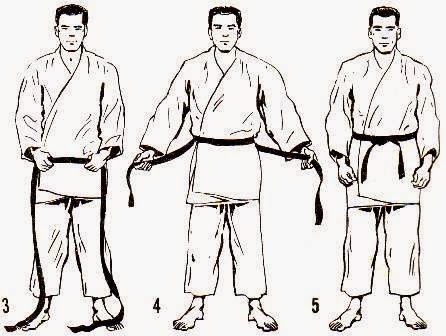
This is an accessory that is both useful and honorable: the belt. It is what keeps the size of the judogi jacket .. It is made of heavy canvas. Its width is approximately 4 cm and a length of approximately 2 m. It has no loop. Here's how to fix it: After swiveling the two sides of the jacket one over the other, enter the belt in the middle and place it on the navel (Figure 3). Then go both bands behind his back, cross them on the kidneys and bring them on either side of the body forward (Figure 4). Both ends must be of equal length. Knot them in the middle of the abdomen by a flat knot (fig.5).
And here you are ready to get to know judo!
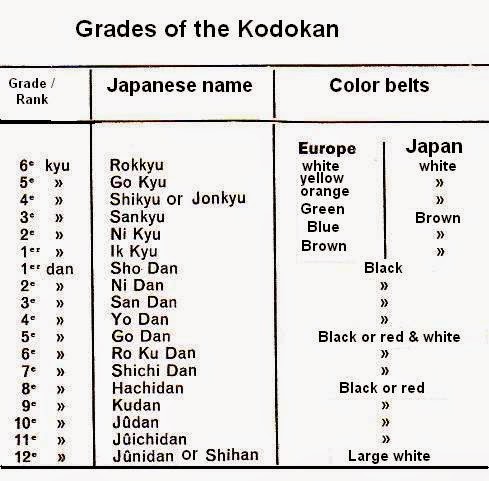
The belt is also the « Grades » of judoka. In Japan, as elsewhere, all education is distributed by « levels » of knowledge and control. In judo, there are six « classes » for the beginner and ten levels for the advanced student.
When you begin the study of judo, you receive a belt ... just to hold your judogi: it is then white. You are considered a 6th class (or kyu in Japanese).
As and as you assimilate the techniques and you become expert in combat, you pass successively 5th, 4th, 3th, 2th and 1thr kyu. In Japan, you are authorized, from the 3th kyu to leave your white belt to the locker room and bring a brown belt. In Europe, Mikonosuke
Kaiwashi, for educational reasons specific to Western students, created the differently colored belt system for each kyu .. This is how the neophyte, after two or three months of the expiry trans dojo, Volt will grant the 5th kyu: he receives from his teacher yellow belt.
Later it every step of kyu, he was successively assign belts orange, green, blue and finally brown. From then, it is more serious candidate for the title of « student advance » (there a few years ago, we said Europe « expert »!). The candidate must then pass serious competition from a very severe examination and finally come before. his superiors, who judge according to his character, his « Judo pass » and other elements. Having succeeded his tests, he gets the famous black belt!
The Process Of Upgrading At Judoka
There are 10 more years, a black belt in Europe was, in terms judo, as well as self-defense or in any other battle mode (force or ground control), the « ne plus ultra ». Today, we get closer over the Japanese reality. Being black belt certainly a performance. Is not willing. It takes a lot of courage to get there. But this is only a first step towards mastery. Indeed, the black belts have levels (dan in Japanese) to climb. There theoretically ten Dans of judo.
When a black belt passes his « pass exams » she was promoted to black belt 1th dan. Then, by training seriously, passing tests after tests, it will access the grade of 2th Dan and then 3th, 4th, 5th, etc ... Since there is no perfection in this world: no limit the grades. It is therefore possible that a 10th dan through diligent practice, reaches a perfection that she be granted the 11th dan. Jigoro Kano, the founder of judo, was given the title « Shihan » posthumously. It was equivalent under 12th dan.
Until this point, all the « grades » are a black belt in training and competition. But when the owner of a 6th, 7th or 8th dan attends as an arbitrator or guest of honor in the judo event (championship, gala, conference, etc ...), he wears a red belt with white section. Beyond the 8th dan, the gala belt turns red. For the 12th dan, it is considered that the holder of an extraordinary distinction has reached such a level that exceeds any class. He then returned to « the source » and wears a white belt. But to some neophytes are not mistaken (!), The latter
is twice as wide as the beginner.
Before finishing, it may be useful to say (so you can avoid any disappointment) that a life entirely devoted to judo hardly enough to achieve the highest grades. Only exceptionally gifted and tough things can happen. Two or three years of hard work is the minimum required to achieve 1st dan; Then, the training time for each level gradually increases. Here, for each grade, the times necessary: 2th dan: 6 months; 3th dan: 1 year; 4th Dan: 1 year; 5th dan: 2 years; 6th dan: 5 years. Is about 12 years in total to reach the 6th dan ... provided it is an exceptional champion, beat all opponents in special competitions and pass exams more difficult! If the steps are respectively 2, 3, 4,5,6 and 9, whether 33 years for the 6th dan only.
Beyond, the grades are less dependent competitions, although it is always demand excellent shape. The criteria are: the high moral judoka, his understanding of the higher principles of judo, its contribution to development, improvement or dissemination of judo. If you start judo at age 15, do you feel so happy to reach 6th dan 50 years ... unless you are a champion, of course. As for the higher grades and since there are 10th in there never was alive two or three at a time. What let dreamer, given that Japan alone,. account 300000 black belts.
Tatami And Judogi
Before going further, talking about the technical secrets of judo and teaching. As for its practice and his mastery, you will find in the section, «Training» in the future articles.
needless to say that theoretical knowledge is not enough: we must study and practice with different partners and repeat thousands of times each take.
The Dojo
You already know a number of Japanese terms (judo, ju-jitsu, Kodokan, etc.). It is customary in most sports, to use the words of the country of origin. (Examples: goal, penalty, time, break, play, etc.). Then do the same, Do not be surprised to hear a strong judo declare yourself: «Yesterday on the tatami dojo, I tore my judogi performing Tai Sabaki during randori with a third dan who wanted me to go uchi-mata» Does this sound barbaric? Every beginner who enters for the first kings in a judo hall is this reflection. But soon, it uses it himself a lot of terms its partners teach him, along with the movements. After three months, everything neophyte may turn pale with astonishment a real Japanese!
But let us see what is a dojo.
Do the term means «way» and the term jo designating a specific place, dojo means «the place or the way we study» or «place of the way»; It is a term of Buddhist origin. The meditation room of some Buddhist temples called dojo. It is also the name of the room or studying a martial art.
Practically, Europe, dojo is used for «club». In fact, modern judo club includes a shower room, a cloakroom, a gym, a living room (bar, library) and ... the dojo (room or studying judo). Ideally, it is a large room, where the soil is covered with a huge carpet. The walls are bare, very clear. Sometimes there hang a photo or two judo techniques: a nice projection, for example. In the center of the wall facing the entrance are fixed one or more symbolic emblems: cherry blossom, a samurai sword, the photo of Jigoro Kano or kakemono (Japanese painting that rolls on a bamboo).
In all, there emerges an austerity climate, profound peace, an atmosphere conducive to the study and serious research. During training, the silence is required and only when required is felt, is questioned or are answered without raising your voice too. A correct and clean attire is required. Any carelessness is prohibited. A master judge penny wind his students their behavior in the dojo. If spectators are allowed, they are asked not to smoke, to discover and to also remain silent. When the dojo was held in this way, it is natural that the judoka soon considered a place of meditation, like an oasis out of the noise.
Besides, how to design a different atmosphere for this exciting ascent to self-control?
The Tatamis
To practice judo at ease, must be able to fall on ground .. pretty welcoming. It must be flexible, elastic and can not cause, in case of falls, no injuries or other trauma. We have seen that the ground at the dojo, is covered with a huge carpet. It is actually a very large solid canvas, under which is a layer of a few centimeters of felt, straw or other material capable to amortize falls.
This device remains very good for a beginner, but it tends more and more to be replaced by a more efficient way. Why? Because we find that these carpets were too soft. lily curbed the speed of movement, weakening relaxing the movements and poorly deadened violent falls. Make yourself the experience: run quickly a dance step on a floor, then try it on a mattress. You will agree that a too soft soil is far from ideal for judo, it is impossible to work on a floor: it would be ideal for the attacker, but the hospital would be to attack. The ideal solution is halfway: is the tatami. The word denotes the mat that covers the floor of any home Japanese. It is made of braided hemp or linen, sometimes rice straw; it is often covered with a clear canvas. Its dimension is standard: about one meter by two meters. These mats laid end to end, create an intimate atmosphere and clean. Are thinking we take off our shoes when entering a Japanese house.
Note in passing that the tatami is used in Japan as a surface measurement. We say: «My room is twelve tatami» or «We have rented an thirty-six tatami apartment», etc.
With regard judo, European clubs employ more tatami factories especially in the Empire of the Rising Sun. lily measure 1.90 m to 0.95 m and a thickness of 6 cm. Lily are made of rice straw sorted, cut and sewn presses in a hessian wrap, covering or better vinyl. The mats are placed one beside the other and held on the outside by a frame. The assembly may be placed either on a fixed floor, or (which is preferred) on a resilient floor mounted on spring or rubber. What is the advantage of such a device? Judo becomes faster, more nervous, more explosive; can take advantage of the finer techniques. And it does not spoil anything, falls are better damped despite the drought of the early impression. Physiologically, the distribution of the shock wave is more homogeneous, the beginner will be resulting in small drops, he will prefer probably fall on a carpet, which receives like a comfortable cushion. But, as he advances in his initiation, falls become more important. it is then found at the time of impact, the vibration of the shock must be disseminated quickly on a large surface, their dispersion attenuating the backlash. But on softer carpet the shock wave is concentrated at the point of impact.
The judogi
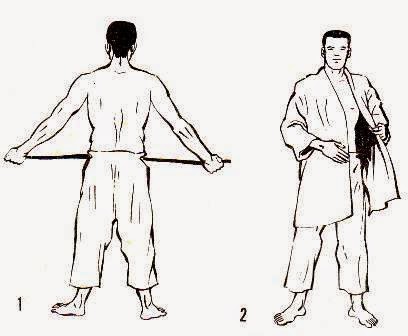
As a fight "real" is waged between opponents dressed, judo takes this into account. Judokas are not fighting in jersey, but dressed in trousers and a jacket. Fighting techniques are also influenced largely by the garment, even to the point of use as a means of attack (I speak in a later article). But fight close combat coated with a ordinary clothes, could be very expensive: the garment will tear at the first tussle. It was therefore necessary to design special equipment for judo: the judogi or keikogi. These words mean respectively «judo suit» and «training suit » In Japan, on-the employs one for the other. The pants are very solid white canvas. There is ample, no knobs or zipper. A cord passes into a behind the scenes along the belt, order to fix the pants waist (fig.1). The jacket is woven into a thicker, stronger even than the canvas pants. Moreover, it is generally reinforced collar, armpits and other parties susceptible to tearing. It is white and has no button or other locking system (Fig.2). Judoka puts this outfit by keeping him a slip. On the carpet, it will evolve barefoot, they play a very important role not only for displacements and detents, but also for countless outlets. The foot of a trained judoka is besides always perfectly muscled.
 |
| Find the best judo clothes at good prices ... Click here |
Subscribe to:
Posts (Atom)